Recent Posts

Showing posts with label art. Show all posts

Sunday, May 15, 2011

Preparations and Renovations


Lo! The end of classes is upon us!

There is, officially, less than a week left of this semester. Unofficially, I'll have all my work in on Thursday. And with nothing scheduled for the summer, that means I can actually plan to successfully Work for Realz.

This is very exciting for me. Anyone who has read this blog for the past year knows I'm terrific at getting ideas and making plans. Very seldom do I actually get things done, however (I still have an ongoing painting started in the summer of 2009 nearly finished.) There are lots of reasons for this, the top ones being that I'm so often Working on Assignments. I don't know how to only spend 40 minutes or an hour on a drawing. I draw or paint until it's good and right. So school assignments eat my time.

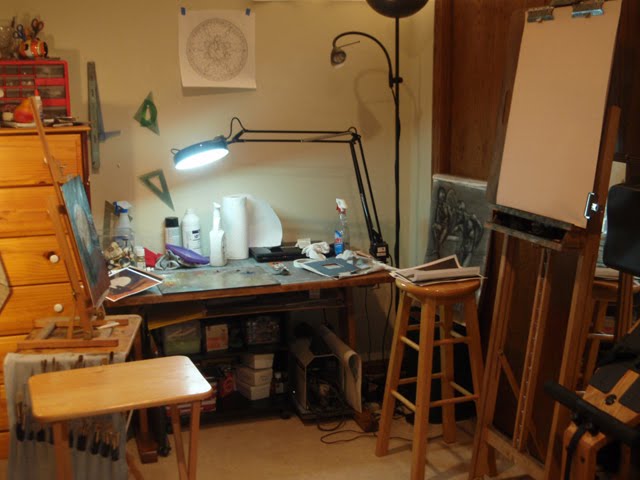
I can also only spend so much time wrestling artwork in that little corner pictured above.

If I really want to get some things going this summer, as I plan to, I figured I need to do some renovating. You see, my art-studio space kind of suffered a crisis several years ago when I put all my stuff away and said I'd never draw again. At the time, I was using a very large former bedroom and had plenty of room for two big easels, a worktable, a drafting desk, lots of bins and carts and so forth. But when I put everything away, I decided to make that room a living space, and so turned 2/3rds of the room into a bit of a home theater - big TV, surround sound, big couch, etc. That left me with 1/3rd to use as a workspace when I started drawing and painting again. As you can see above, it's been a little... close.

The other difficulty is that the computer/scanner is in the other room. These days I go back and forth so often between sketchbooks, Photoshop and Painter that I'm constantly carrying things in and out of the smaller office room, which has also been suffering a bit of an identity crisis. In my youth the office was the "playroom" and sewing room, sometimes even a guest room. Ever since our first IBM PC, it's had a computer of one sort or another in it, and for a while had two. Presently it's got my work computer and the printer/scanner/fax, along with a lot of half-used office/storage furniture. It has a large, poorly-used closet and harbors the catbox. I replaced the flooring and repainted a couple years ago, and it's now a lovely neutral shade of gray.

Behold this poorly composited photo:


The glass desk with the big monitor is where I generally do my digital painting and such. It's been problimatic for years because it constantly conducts static electricity to my (homebuilt) PC, switching it off or killing the USB devices if I dare move (usually only in the winter.) I don't know how much work I've lost because of this, but it's been infuriating at times.

SO, after much deliberation, I've decided to take that little office room and turn it into a studio workspace. It is small, but small can be efficient, too. Small can mean I can turn around and flop a sketchbook onto a scanner. Small can mean I can bring up a reference right on a computer screen in the room I'm painting. Small can mean all the mess is concentrated in one space.

Most of all, small means I can open the door to go to work and close it behind me to stop. If you don't get what that means, well, it's probably the biggest challenge when working from home. When your prime workspace is in the same room as the TV and the couch, it's not easy to focus. When your prime relaxing space is in the same room as your workspace, it's not easy to relax. Secondary to the huge time-eater that classwork has been, this has been my biggest stumbling block. It's time to get a new, clean, efficient workspace in order.

And at the same time, reclaim my living space from the charcoal dust and paint!

Thanks to a nifty little online floorplanner I figured out how to fit all my work stuff in that one little room. The glass desk will be brought into the TV room as a home for my Macbook, which has been living on a lapdesk by the couch for the past year. Thankfully the aluminum unibody makes it near-impossible to shock! My work PC will move over to the unused wooden computer desk with the printer/scanner, and my worktable and easel will get moved in where the glass stuff used to be. Big Cabinet will get shoved in the closet - it WILL fit! Catbox and Cattree get moved into the TV room, to get tucked behind a door. The cats will just have to adapt to their change in facilities!

It really ends up giving me a decent space, with all the storage and tools around me that I need.


It's such a relief - and so exciting - just to have this all worked out. I've been trying for several years now to Get Things Done with the current setup, and it just hasn't been working. So once everything is handed in Thursday, I'm going to moving things around. There's some shoe molding I never got in after laying the floors in here years ago, and tons of cleaning and clearing-out to do. Rearranging closet-space. Spackling and touching-up walls. Getting everything cleaned up and organized and ready to do stuff in again.

At very least, it's a good place to start.


Thursday, March 10, 2011

Stretching


Forgive me if I've written about this before.

One of my biggest frustrations right now is not being able to create what I want to create. Most of what I post here is academic classwork. Figure drawings, still life paintings, studies, etc. that are all created according to assignment parameters with suitable references. I spend a great deal of time on my schoolwork, earn appropriate grades for the time and effort I put into it all. It all looks good and I'm quite content with it, and growing ever more confident in my ability to do a nice figure drawing or paint a still life, or whatever else is asked of me in my classes.

That's not to say I'm not learning anything - the practice alone, of having to do two or three detailed and polished figure drawings a week - is invaluable. The classes themselves have tons of wonderful practical information organized in a way to make learning and understanding easy. I've progressed more in the past two years at AAU than I ever did before.

On the side, however, I'm constantly looking at other artists, tutorials, articles, how-to's, books, and other information. I'm also always experimenting. Usually the experimenting comes in the form of something drawn from my World of Warcraft playing, as that's what my friends and I are talking about all the time and it's fun to interact with them about it. It's a great source of ideas. It's also a great way to pinpoint where I'm lacking.

Schoolwork doesn't tell me where I'm lacking, because I'm not yet focusing on what I really want to do. I'm learning and perfecting, but I'm not *stretching*. Stretching involves going beyond what we know, what we're confident in. It involves reaching for something we can only imagine.

This is slightly related to my entry last week, about the huge difference between free-drawing and relying on copying. This takes it a step further, to the difference between relying on references and working from our own heads. This is where I see the huge bulwark of frustration in my own work. My little experiments are not near what I want them to be. My weaknesses blare out like overzealous horn sections and make me wince and want to look away.

But I'm more driven to keep stretching than anything else.

It's difficult at times to watch a tutorial - like the one I was watching Here, a great resource, the other night - and then attempt to do it myself... and fail miserably. Maybe not giving myself enough time, maybe trying something *too* difficult, but still, the obvious weak points bubble to the surface and infuriate me.

It does no good to feel badly about it, or to sulk about being yet unable to turn out awesome drawings and paintings. The only things that can be done is to look at what works, what doesn't, what can be improved next time. And try to build up some plan of attack to tackle those weak points so there are fewer and fewer Bubbles of Disappointment each time.

My short list:
  • Spend more time and attention on composition (Still Life course helping here)
  • Push values and colors even further (Still life also helping here)
  • Create a focal point and let everything else gradually fall back (Anatomy drawings helping here, actually, in ways I hadn't expected)
  • Don't rush the drawing (I have a horrible habit, when working away from the easel, of skipping steps in drawing and ending up with incorrect proportions)
  • Settle on a color scheme (lessons from Color & Design)
  • Be more accurate in realism and detail (Slow down, practice practice practice)
Even the short list, at times, seems insurmountable. The only thing I can do is try again, with another silly little piece of WoW fanart, or some idea thrown to me by a friend. It feels sometimes that no matter what I do, it will never click together how I hope it will, and I'll be left doing nice drawings and paintings from photographs and references. But the storyteller in me begs me to keep stretching, keep trying.

So keep trying, I shall.

Thursday, March 3, 2011

It's All How You See It


I'm going to write something here that may be a little controversial and/or rub people the wrong way. It's been getting under my skin, though, for a while now, so I just have to say something about it.

I've noticed, especially lately, that there are a whole lot of people out there doing a whole lot of tracing of reference sources, layering over in Photoshop, or using a grid to get their subject on their canvas, whatever that canvas might be. Before I say anything else, I want to insist that all of these techniques can be wonderful tools. I've had instructors comment to students to use a grid to get a proportionally-correct drawing; I've had assignments that stated specifically to use a grid. I've had instructors give the very good advice to trace a reference onto a sheet of translucent paper, then hold it up over a drawing to see where the drawing is wrong (actually, the best way to use tracing.) I'm certainly not talking about using layers in digital programs or sheets of tracing paper to gradually perfect a drawing, either. Basically, I'm talking about using these tools to an extent that you're doing little to no drawing yourself, and doing so until you're dependent on it.

Related to this is the use of the eyedropper tool in digital art to pick up original colors from a reference. There's TONS to be learned by doing this on a few practice paintings, but someday you have to learn to mix those colors yourself. Just like someday you have to learn to draw what you see without any training wheels, without anything showing you the way but your own eyes and sense of space.


I have done all these things myself. When I was doing aviation art, I regretfully admit, I did very little raw drawing. I did a whole lot of gathering reference material and composing a scene, then tracing it onto a canvas. I think it's part of the reason I never felt like a "real" artist in those days. I was painting decently, and I could detail those traced drawings like crazy, but the gist of being an artist escaped me because of the shortcuts I was taking. I was more of an artist when I was in 11th grade, drawing from scratch photos cut out of magazines, than I was when I was making the most money painting airplanes.

When I began classes at AAU, it was that time spent drawing when I was a teenager that came back to me, and the lessons I learned when given Drawing on the Right Side of the Brain when I was 13. Contour line drawing. Drawing upside-down. Drawing negative space. I didn't understand sighting until I got the hang of it in my first class, but after that, it all seemed to make sense. No, it's not easy. It's not always quick. It's not always perfect. But it's incredibly liberating to be able to draw anything you can see before your eyes or in your head with nothing but a pencil in your hand.


Drawing, at its core, is all about seeing relationships. It's about judging the distance between two points, or discerning the angle of a line drawn between them. Drawing gets down to geometry without the numbers. Even if there is only a dot on a page, there's still a relationship between that dot and the corner, or the dot and the edges. If you can judge the relationships, you can take a blank sheet of paper and draw the dot in the same exact spot as the original. Try it. It's a fantastic exercise for *seeing*.

We trace and we grid and we use these tools to correct our imperfect, unpracticed sight. We use them to *learn* where that dot is. The important question, however, is are we using them actively, or passively? If I simply lay my empty paper over the paper with the dot, and make a mark where I see the dot showing through, what am I learning? I'm merely following train tracks, doing nothing myself. However, if I do my best to see where that dot should be, and put it down where I think it should go, THEN lay it over the original to see how close I was to the original mark, and look at the difference, and correct myself, then I'm LEARNING.

We should always, always be LEARNING.

Learning to see is like any other skill. It's like hearing intervals in music or knowing how hard to press the brakes in your car to slow to a stop. Learning to see allows us to look around our world and see it for what it really is, and manipulate that reality to create art. It allows us to take the clear visions we see in our heads - in whatever imaginative style we see them - and put them down on paper, on canvas, on our computers. Seeing relationships correctly is essential in every visual art, whether fashion design, graphic design, interior design, fine art, illustration... We have to be able to put down something that makes visual sense. There is not always a template. There is not always a reference you can trace or copy. The beauty of our own art should come from how we uniquely see and recreate our subjects. You can't be unique and creative and fully develop yourself as an artist if you're constantly riding a train track.


This is not to say, "Throw away your tracing paper, never make another layer in Photoshop again." Copying is a time-tested method of learning from the masters. Just make sure, as I said before, you're learning, and not just taking a shortcut. If you can do it yourself, with your own eyes, do it. Even if you have to go back and correct things after. Learn to see. Learn to draw. Learn that age-old, treasured skill of the artist. It's not something just anyone can do. It's *ours*.

And from there, learn to judge value, to discern color. The world is so much more beautiful when you can see all its shades and hues and know what they really are.

The work on this page is all schoolwork from the past week. There are lots of imperfections, mistakes, areas that could be better. The charcoal anatomical studies took a long time to draw and a longer time to render in value. The still life compositions take no prisoners in their difficulty to initially draw correctly. With all of them, there were moments where I stepped back, grit my teeth, and wiped entire sections off the paper or canvas. All of them were drawn with nothing more than a pencil or brush, my hands, and my eyes.

When you can really see, you can draw anything. The harder I work, the more I progress, the more I desire to learn to see even better. It simply unlocks every possibility an artist could dream of.

Thursday, January 6, 2011

Getting Down to Business

This year, I'm trying something new.

One of the interesting things about being self-employed (as well as being an online student) is handling your schedule. I've had people say to me, "I'd never have the self-discipline!" and I also know there's just as many envying the fact I can (or could!) pretty much get up whenever I want to and never be held to a work schedule set by someone else. One of my good friends is a retail manager who sometimes has to get up at 5AM and be stuck at his store for the next 12 hours. I also think of my mother, who got up at 6AM to go to her classroom until 4PM every single weekday from September until June. That kind of set schedule and routine is incredibly intimidating to me, so hats off to everyone who does the 9-5 thing!

That said, there's also something really important about that kind of schedule, and it's not just the assured work-time. That's the obvious part - that here you've got time set aside to *work*. The less obvious part is that scheduled work days also give a person scheduled time *off*. Sure there are sometimes extra things to bring home now and then, but a lot of folks when they leave work, they leave work.

Working for yourself, you never leave work. It's always there. Prodding you. Poking you. Telling you you'd better look at this or do that. Maybe it comes up in the morning; sometimes it comes up at night. Days set aside to be specifically taken "off" end up with this background static of stress because of all the little work things buzzing at you to be done. Sometimes there just are no days off, and it goes on and on and gets more and more stressful and really unpleasant overall.

So before New Year's - actually, on New Year's eve - I had a long long talk with my buddy the retail manager. I have been worn out, stressed out, not getting enough done and not getting good rest, and wanted to change. He explained to me the *reward* of keeping to a schedule - how if you work 6 hours or whatever, you can then walk away and *reward* yourself with absolutely free relaxation time. That sounded awfully good to me, since because most of my efforts go into schoolwork, I see very little reward from it all (A's are nice and all, but they can't pay for a movie!) So together we worked out a viable schedule which *gasp* included me getting up at a respectable hour, doing nothing but *work* (no breaks for Cheezburger sites!!), taking a lunch break, working some more, then having the evening off.

The evenings are the important bits. During the semester I'd often be working very hard until 9 or 9:30, then it would take me forever to wind down to be able to sleep, then I'd be tired the next day.

So I installed a site-blocker addon for Firefox, made up some schedule spreadsheets and printed them up, and set my alarm for 7:40. This week has been fantastic so far.

I've scheduled two hours a day for drawing exercises. Simple things like drawing a bunch of hands....


Or doing a quick master copy...


Or just experimenting with Painter and Photoshop (that's scheduled for this afternoon!)

In between those two exercise hours I have "project time" - which could be anything. This week it's updating and redesigning my website, dekraus.com. I've learned some Flash to build some custom galleries, and will hopefully get it up and running by next week.

Tuesday is a day off, since that's grocery day! I also took Sunday off, since my mom and I often have brunch that day. On Tuesday I just relaxed, played games, did some chores, but then in the evening I ended up drawing just for my own pleasure, a little sketch of my WoW goblin, Elli:


I don't know how often I've *wanted* to do little sketches like that but never had the time, because there was always work to do. Drawing for fun on my days off?? What a concept!

So my New Year's resolution is to stick to this schedule. I'm really curious how it will work for school, and really hopeful it will help prevent some of the exhausting 12-hour painting marathons I had last semester. At very least I feel like I'm really working, and not just *trying* to work, which is a subtle thing but very good for my whole mentality.

The other good thing is that I've got in the schedule to update this blog once a week. No more months between updates! I promise!